
AI Squats

In the first meeting with students this semester, I shared my New Year’s resolution: doing more squats. They looked at me puzzled. Then I elaborated. I want to do squats when I outsource something substantial to AI, like asking Claude Code to build a feature or playing with new vision models on Google AI Studio. Physical squats, while I may otherwise be waiting or multitasking.
Some felt amused; some LOL’d. A few said they’d check on my squat counts. Others wanted to try it themselves.
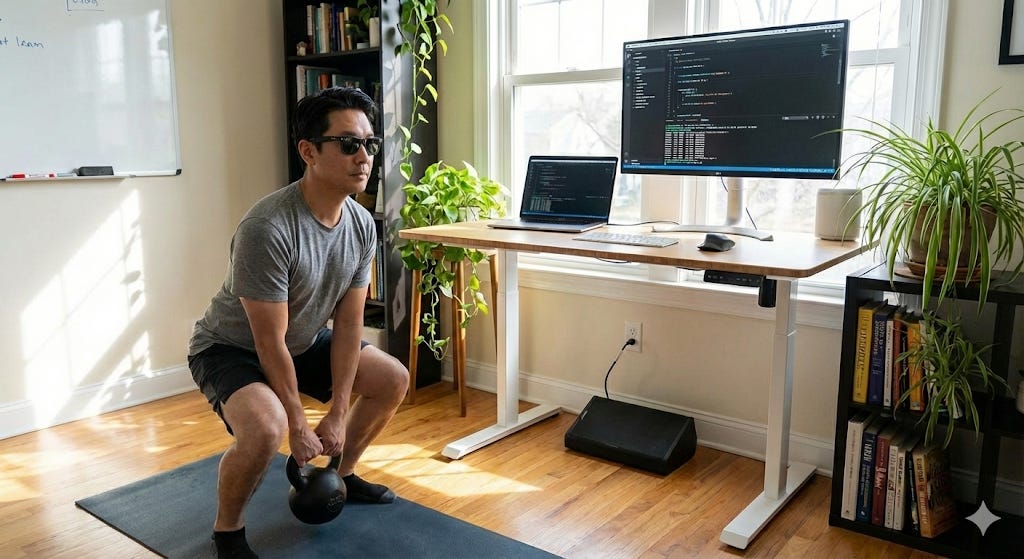
Why squats? I shared with them two practical reasons.
1. Feel the burn
If I’m outsourcing something that would take me significant effort – say, building a feature in minutes that might take me weeks (if I could do it at all) – I want to feel something. Squats keep me grounded and not too detached from the history. AI has eased some part of our work. Feeling the burn is the human thing I can still keep.
2. Slow down and maintain human scale
I wrote about “AI lag” last year, and this feels related. When Claude Code makes a plan estimating “Phase 1: 2 weeks” and then finishes it in 5 minutes, the contrast between human speed and AI speed becomes visceral. If I try to keep pace with that speed, I’ll physically collapse. (This might explain why some programmers report feeling more tired these days, even as AI makes their work more efficient.)
I thought those are two good reasons to do those AI squats.
But there’s something deeper here that I’ve been mulling over.
Squatting as a third position
Most AI discourse offers two contrasting stances:
Standing tall (human over machine): “We control AI, we direct it, we master it”
Sitting down (human merged with machine): “We collaborate seamlessly, AI augments us”
We discuss these positions with students while reviewing course policies. But both start to feel inadequate to me. Standing is rigid and defensive; it exhausts you and denies AI’s transformative power. Sitting is passive and too comfortable; you lose critical distance and risk being colonized by the tool.
Squatting offers a third way: engaged alertness without domination. Grounded without settling. You’re always seeking balance, always needing to adjust your posture to last.
Maybe interacting with AI requires exactly this kind of sustained, uncomfortable, engaged positioning. Not the bravado of standing tall. Not the ease of sitting cozy. But the deliberate discomfort of squatting – a posture that says: I’m here, I’m paying attention, and I can feel the burn.
So here’s my invitation: the next time you ask an AI to do something substantial for you, try a squat if possible. It might just be the posture – physically or figuratively – that we need for this moment.
What’s your posture when working with AI? And what would it mean to cultivate a different one?