

Last week, I caught myself feeling exhausted after what should have been a productive morning working with Claude Code on hobby projects. I'd accomplished more in three hours than I typically would in two days—planning features, refining UI, fixing bugs, mostly letting Claude Code rip—yet I felt more drained than energized. It felt like drinking from a fire hose while also trying to taste the water (even though I've not personally tried it). This got me thinking:
If AI is supposed to make us more efficient, why do I feel like I'm running harder just to keep up?
This paradox points to something deeper than individual productivity. We're experiencing AI-induced temporal entanglement—a phenomenon in which human time and machine time become inseparably intertwined, creating a form of temporal exhaustion that is not really new to our species but is now further intensified by AI adoption.
The Acceleration Trap: Why We Can't Slow Down
Here's what I've noticed in my experience: Once AI raises the speed expectation in any area, we collectively can't slow back down. When Claude Code can build a new feature in minutes, suddenly taking a day feels anciently unproductive.
This is what we might call an acceleration trap—not a conscious decision to go faster, but rather being swept up in a dynamic where our collectively AI-augmented pace becomes the new baseline. The acceleration occurs at the micro-level, in those prompt-response interactions, but scales up to much broader and deeper societal re-configuration. Even if you personally want to slow down, you can't, because everyone else or your organization is synced to machine speed.
Research by Katy Tam and Michael Inzlicht (2024) reveals a similar picture of our relationship with digital media. They document a significant rise in reported boredom from 2009-2020—precisely the period when smartphones and social media became ubiquitous. Counter-intuitively, with more entertainment options than ever, people are becoming more bored, not less. Chronic exposure to stimulating content raises our threshold for what feels engaging. Previously engaging activities become boring when our expectations for stimulation increase.
AI seems to be doing something similar to our temporal expectations. Just as endless scrolling makes ordinary moments feel dull, AI's relentless speed resets our baseline for what counts as "productive time." It's like a temporal ratchet: once AI accelerates our expectations, it's difficult to turn back. The gears only move forward, tightening the pace, making any attempt to slow down feel unnatural—just like standing in a long line without your smartphone in hand.
"AI Lag": The New Temporal Illness
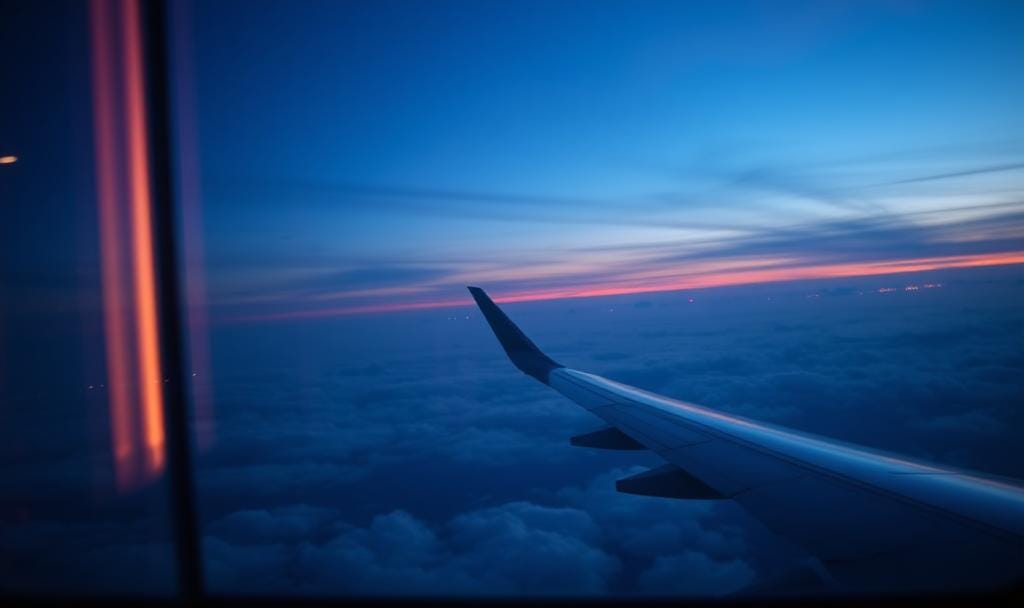
For international travelers, jet lag is a familiar phenomenon—we know the grogginess, the recovery rituals, and the rough formulas for how many days it takes to adjust after crossing time zones. Our biological rhythms, finely tuned to the earth's rotation, need time to recalibrate after the abrupt disruptions of air travel.
Now, working with AI is creating a new kind of "AI lag"—a kind of temporal jet lag from constantly shifting between human and machine rhythms. It's the exhaustion that comes from trying to sync with AI processing while remaining human.
Unlike traditional tools that operate at a slower pace or expect human passivity (like scrolling), AI functions at microsecond speeds while (mostly) expecting active human input and judgment (which is not a bad thing in itself). This creates a demand on humans that is qualitatively different from other forms of burden. We are essentially living with constant temporal misalignment in our own technological environment.
Tam and Inzlicht's research demonstrates how digital media divides our attention and disrupts our ability to maintain focus. Young people receive a median of 237 notifications per day, resulting in constant interruptions that fragment their sense of time.
While AI interactions often involve more intentional human input, they introduce their own kind of temporal fragmentation—rapid task-switching between human and machine processing that leaves us cognitively exhausted, inducing "AI lag" constantly for a broader spectrum of people.
When we combine this emerging "AI lag" with the relentless demands of the attention economy (as Chris Hayes explores in The Sirens' Call), it becomes clear that the AI game is not only about a race among AI models, but also commercial models that try to harvest even more human resources: attention, labor, and wellbeing. From cable news to social media, people have perfected the craft in harvesting human attention. Now, it seems there are opportunities to level up by amplifying AI lag at scale and convincing the public that a new state of AI-induced temporal entanglement is completely normal, thereby establishing a new sense of normalcy.
Toward Temporal Intentionality
One of the most troubling aspects of the acceleration trap, to me, is how it erases temporal gaps—those moments of waiting, reflecting, or simply being present without the urge to do anything, or to attend to no more than one's own thoughts.
My childhood is full of such moments. I remember summers in a small village in Sichuan, China: the air heavy with heat, the endless buzzing of cicadas, the gentle ripple of rice fields as the grains grew heavier, all occasionally interrupted by sudden thunderstorms. Summer felt still, but never boring.
Many Indigenous cultures lack a word for "boredom." Time is experienced as cyclical rather than linear. In these contexts, "empty" moments are not voids to be filled, but natural rhythms to inhabit.
What strikes me about this moment is that we're caught between temporal worlds. We are implicitly forced to adapt to machine time, and most of us can no longer operate purely in human time. This creates a pathological mismatch between our biological rhythms and our technologically mediated social rhythms. AI doesn't just speed up isolated tasks—it restructures the temporal fabric of how we interact with information, ideas, and each other. We're not just using AI tools; we're living within AI-mediated temporal environments, enduring the AI lag as a new temporal illness before we notice it.
In the meantime, this transition presents new opportunities to intentionally shape our relationship with technology and time. The key question is not whether we should resist or embrace AI-driven productivity, but how we can cultivate intentionality—deliberately choosing when to engage with machine speed and when to preserve a human pace. This might involve creating intentional "slow zones" in our experience—periods explicitly protected from AI acceleration—or developing new rituals for transitioning between machine time and human time.
We need to ask many questions: How might we design workplaces that honor both the efficiency of machine time and the wisdom of human time? What would education look like if we took temporal entanglement seriously in emerging AI literacy programs? What new forms of collective coordination might emerge to help us organize machine and human time? What new forms of inequality may emerge if some people have the freedom to stick to human time more than others?
These aren't abstract questions—they're becoming practical design challenges as AI becomes more deeply integrated into the infrastructure of daily life. The temporal choices we make now will shape whether AI benefits human or simply creates new forms of technological overwhelm. This choice doesn't require any debates on the existence or timeline of AGI.
The future may not be about choosing between human time and machine time, but learning from history and choose to dance skillfully between them.
This is my third Substack post—thank you for joining me in exploring these questions about AI, time, and human experience. I'm excited to continue this conversation if you are grappling with similar challenges at the intersection of technology and temporality.
"Once AI raises the speed expectation in any area, we collectively can't slow back down. When Claude Code can build a new feature in minutes, suddenly taking a day feels anciently unproductive." This can't be more true!
I appreciate the distinction you draw between human time and machine time, and how we are constantly forced to keep up with the machine time at the cost of human wellbeing.
I found your blog posts very refreshing. They are not as dense as academic articles but definitely do not fall short of insightful gems! Thank you!