

Education leaders have spent more than two years grappling with artificial intelligence in schools. By the end of 2025, 34 states had issued formal guidance on AI in K-12 schools, and Education Week reports an unprecedented wave of legislation defining the technology, setting rules for its use, and advancing AI literacy. All of it is AI policy written in public.
But AI slipped into my kid’s school largely unnoticed. I only spotted it a few months ago, when a new button appeared on the learning platform that teachers, students, and parents log into, greyed out and easy to miss. There was no board meeting, pilot, or parent night. The technology arrived through a software update.
I think this quiet arrival of AI needs serious attention. The public discussion is still dominated by cheating or cognitive atrophy, which are legitimate but surface-level. The consequential changes are happening out of sight, inside the digital infrastructure schools already operate on.
Besides whether to use AI, a deeper question is who decides how AI settles into a school. Answering it well means thinking less like someone shopping for a tool and more like someone renovating a historic building.
Buildings change at different speeds, and so do schools
A building, the architect Stewart Brand points out, is several things stacked together, each changing at its own speed. The furniture gets rearranged in an afternoon. Interior walls might move every few years. Plumbing and wiring last a decade or two. The structural frame stands for a century. The ground is, more or less, permanent. Brand calls these things pace layers.
For a building, trouble comes when a fast-layer change undermines a slow one—when a renovation compromises a load-bearing wall by accident.
Schools have layers like this too. Let’s consider these layers running from fast to slow:
• Practices: what happens in a classroom on a given day
• Plans: lessons and assignments across a week or month
• Protocols: norms and policies that hold for a year or more
• Pedagogies: approaches a teacher refines over many years
• Principles: what a discipline counts as deep understanding and good teaching
• Philosophies: the underlying view of what education is for
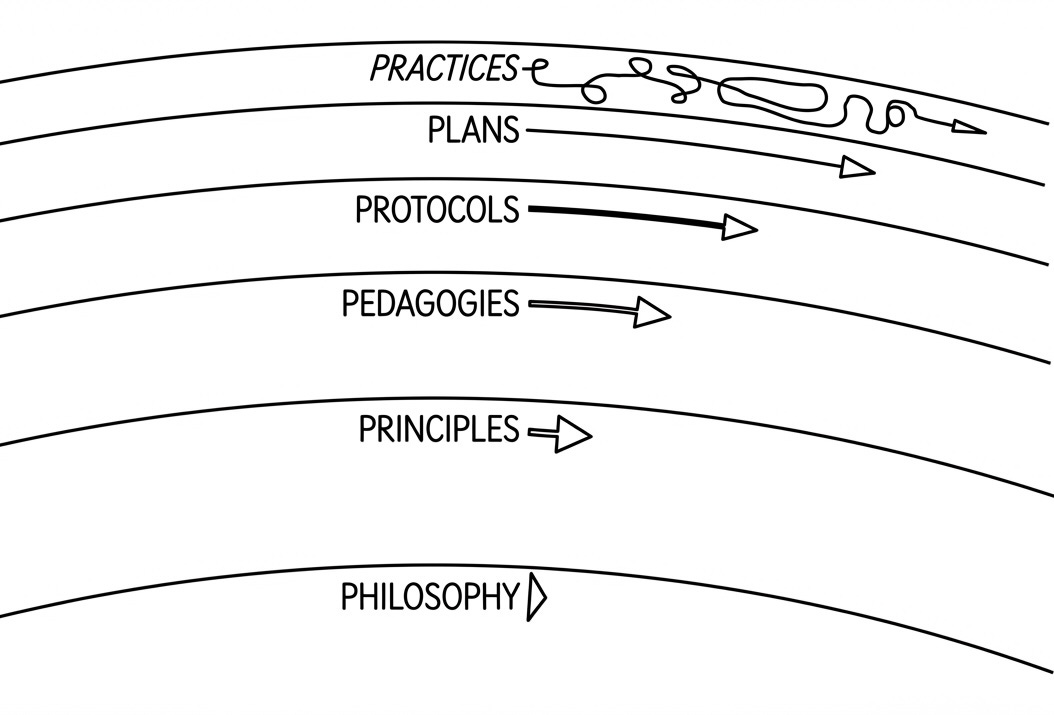
The fast layers are where you experiment. Try a different discussion question, drop an assignment, change the seating. The slow layers hold steady, so a teacher’s sense of how writing develops isn’t dictated by whatever she tried last Tuesday. That is how a building learns, according to Brand. The fast layers propose; the slow layers decide what’s worth keeping. Schools can learn this way too.
AI breaks this arrangement by the way it arrives. It shows up as a fast-layer convenience inside the platforms schools already rely on. A teacher uses it to generate one reading passage at three difficulty levels in seconds, and at a glance that seems like a no-brainer.
But the convenience carries assumptions she never agreed to, ideas about good reading materials and differentiation. Use it a dozen times and those assumptions sink into slower layers she never means to change. Each use feels trivial, often a harmless time-saver, until reasoning about pedagogy has been edged out and the wall has moved.
Think and work across layers
Take a moment many teachers will recognize. A student comes up after class and asks whether he can use ChatGPT to outline his essay.
Answer it on its own terms, yes or no or yes-with-conditions, and you settle only today. Tomorrow another student asks about drafting, next week about sources, and no one brings up what outlining is actually for.
Architectural thinking starts by asking which layer the question touches. On the surface it is a practice-layer question about using a tool. But when you reach down to the pedagogy layer, it is about what outlining does for a developing writer; under that sits a principle, that organizing your own thoughts is part of how anyone learns to think. The architect’s job is to tell which layer a decision actually moves. Is the student rearranging furniture, or quietly taking out a load-bearing wall?
Thinking across layers changes how you decide. If outlining is load-bearing, the question is no longer whether the student may use ChatGPT but how he can use it without pulling the wall down. The teacher, after contemplating, may suggest he draft the outline first, then use ChatGPT to critique it. That is design work led by the teacher, and it is what architectural thinking offers, beyond what the tool ships.
What this asks of schools
No teacher can do this alone though. Platforms and busy schedules push for speed, and deliberate work takes structures the school has to build. Three shifts would help, and none requires better technology.
First, look past pass-fail pilots. Whether an AI tool “works” depends less on the tool than on the design a teacher builds around it, and how that design connects to the existing layers. Education is too layered for a naive verdict.
Value the teachers who are thinking and experimenting with AI. Fitting a tool to their own pedagogy is real architectural work, and policies and protocols should not throttle it. Give those experiments a path into the slow layers of the school, learning from them instead of losing them.
And support administrators to ask slow-layer questions when they make strategic decisions about AI. When a vendor shows off an efficiency metric, ask what it does for the instructional method the school has adopted two years ago, or what AI means for its English language learners.
We don’t know what AI will look like in 2030, or which of today’s tools will last. But the structure of a school outlasts any particular tool, the way a building outlasts its furniture. The decisions made now—about which layers AI gets to reach, and who gets a say—will outlast today’s AI features decorated with sparkles. Better for schools to decide on purpose than to let a software update decide for them.