

Last month, I presented in front of a room full of faculty from across Penn—historians, law professors, health sciences educators, psychology professors—all grappling with the same challenge: What do we actually do about AI in our classrooms? Not the hypothetical future version. The one that’s already here, that our students are already using.
I wasn’t there to offer a universal solution. To be honest, I’m skeptical that one exists. Instead, I wanted to share something more concrete: How I applied a set of pedagogical principles that I follow to two very different courses, and how I ended up with completely different approaches to integrating AI in these courses.
The Pedagogical Grounding
Before I get into the specifics, let me back up to the foundation. My approach to AI in teaching is grounded in two ideas that long predate generative AI.
The first can probably be best described in words by John Dewey: “Education is not preparation for life; education is life itself.” I’ve always taken this to mean that classrooms should engage students in real experiences, not just simulate them or prepare them for some distant future. What we do in our courses is the work, not prep for work.
The second is a question I keep returning to: What do professionals in our disciplines do? How are their practices evolving? If students we teach are entering various fields of practice (and I think we are, even if that’s not the only goal), we need to understand what authentic practice looks like right now, if it’s impossible to predict what it looks like in the future.
These two frames shape how I think about AI integration in my teaching. AI is present in professional practice across disciplines. It’s evolving those practices. So the question isn’t whether to engage with it, but how—in ways that align with genuine disciplinary work and create authentic learning experiences.
Course 1: When Learning Objectives Change
My Programming Fundamentals course is for education majors in my school. Students taking this course need to understand code but are usually not trying to become software engineers. Before integrating AI, the course focused on Python syntax and programming concepts. Students wrote code from scratch, debugged line by line, built their understanding through repetition and error. Last year I developed a custom GPT as a learning assistant for students but that didn’t change the focus on learning programming syntax and skills.
With tools like Claude Code and Github Copilot widely available, I had to ask: What’s the authentic practice my students need to engage in? Professional developers are already using these tools. More importantly, what did I actually want my students to take away from this course?
As a result, the learning objectives shifted. Instead of learning Python syntax as the primary goal, the course became about solving programming problems with Copilot. Students still need to understand what code does—perhaps even more so now—but the focus moved to problem decomposition, project planning, code comprehension, and critical evaluation of AI-generated solutions.
For students, this changed everything. The bottleneck is no longer syntax memorization. It’s understanding the problem well enough to prompt effectively, and evaluating whether the solution actually works. Of course, they’re still building fluency in syntax and concepts along the way. But Copilot is an integral part of their learning journey, explaining code, generating initial drafts, providing personalized support when they’re stuck, etc.
Last week, students reflected on their experiences so far. What struck me most was their acute awareness of the “learning paradox”: AI makes programming accessible and reduces intimidation, but “am I learning to code or just learning to use AI?” They noticed how easy it is to get answers in five seconds. In response, students themselves developed various strategies: turning off autocomplete to practice independently, planning before prompting, actively reading and questioning AI-generated code rather than passively accepting it, and so on. We spent half of the class talking about AI reliance and metacognitive awareness of one’s own learning. It will be a continuing struggle--a good one that builds necessary muscles for walking alongside AI.
Course 2: When Learning Objectives Stay the Same
My Foundations of Learning Theories course serves first-year master’s students. The core learning objectives are: 1) understand foundational learning theories; and 2) apply theories to authentic educational problems (ideally their capstone projects).
AI is also integrated in this course, but the objectives haven’t changed. Students still need to read the original papers, wrestle with complex ideas, develop their own theoretical perspectives.
But here’s one thing that I added: Students get to use an AI-based tool called ChatLab that allows them to simulate dialogues or debates among theorists about their authentic problems. They’re still doing all the reading (hopefully). They’re still engaging deeply with theoretical concepts. The AI doesn’t replace that work—it augments their ability to sharpen theoretical understanding and connect theories with practical problems.
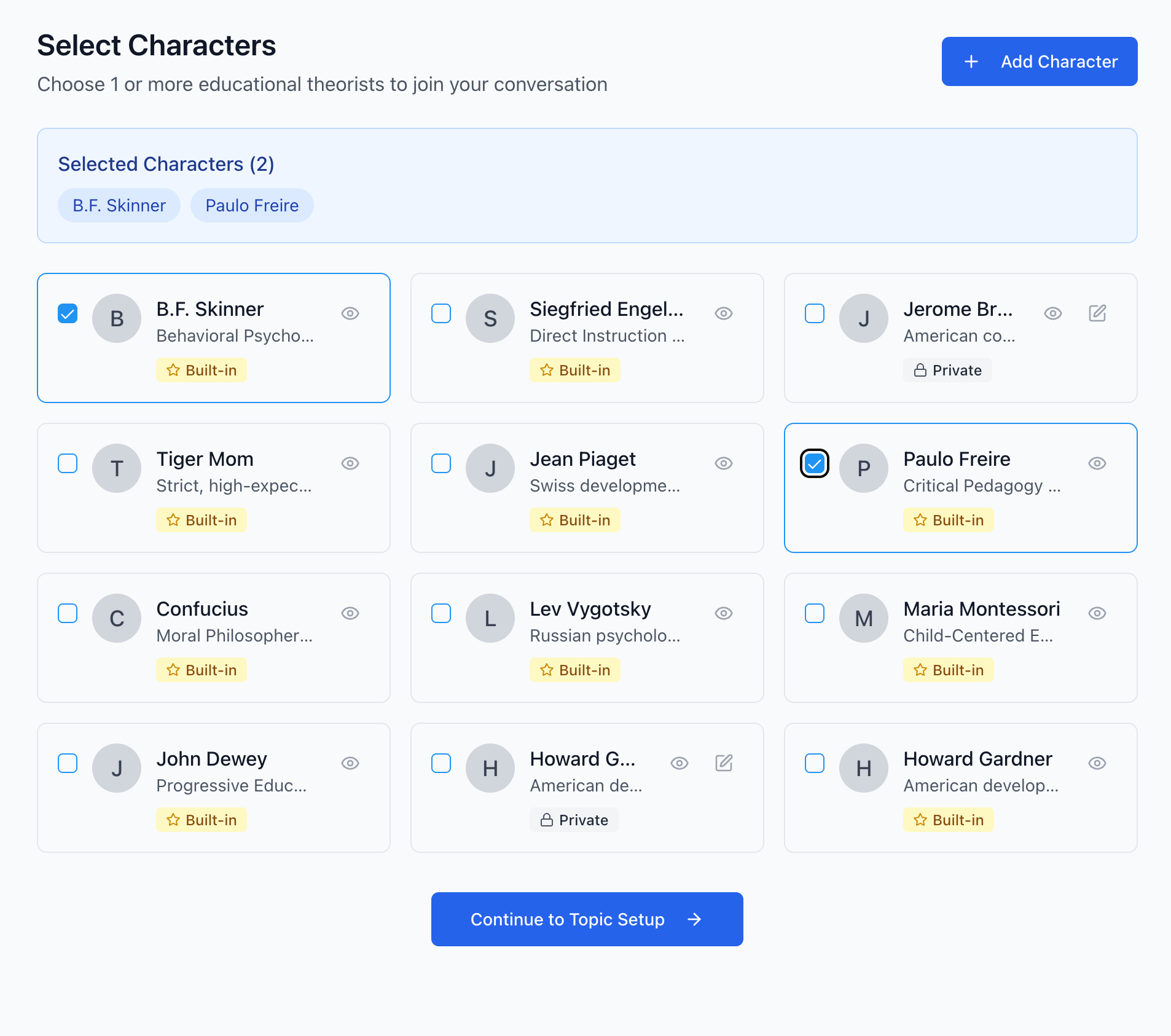
In their continuing reflections, students described using ChatLab to pose questions that mattered to them and engage in simulated dialogues with theorists like Vygotsky, Gee, and Wertsch. Some explored how culture shapes learning, drawing connections between sociocultural theory and their own experiences as learners from diverse backgrounds. Others pressed the tool on practical applications, asking what a group of theorists who lived decades ago may have something to say today’s problems, such as classroom challenges around AI integration. What emerged wasn’t just comprehension of theories in isolation, but a capacity to think with theories about problems they cared about.
A Policy Built on Trust
Both courses share the same policy on AI use. It’s straightforward: Responsibility plus Transparency. Students won’t be penalized for using AI tools. Instead, I ask them to acknowledge when and how they’ve used them, particularly in written work, and to keep records of their interactions.
This policy rests on a belief: that students can become thoughtful, critical users of AI within their disciplines. That they’re capable of making good decisions about when AI serves their learning and when it doesn’t. That they’ll take responsibility for the work they submit, regardless of what tools helped produce it.
Does this work perfectly? No. But I believe it offers a more productive space for exploration and dialogue than policies that prevent AI use. This approach opens up conversation and models the kind of judgment I hope students will develop.
So What Does This Mean for You?
I hesitate to extract universal lessons from two courses in one discipline. But a few patterns emerge that might be worth considering:
Start with your disciplinary practice. How is AI already changing (or not changing) what professionals in your field do? What does authentic work look like now?
Be honest about your learning objectives. Are they actually achievable in a world where students have access to powerful AI tools? Do they need to shift, or can they be met in new ways?
Different contexts genuinely require different approaches. My programming course and my learning theories course both embrace AI, but in fundamentally different ways because the learning goals are different.
Transparency matters more than control. I can’t prevent students from using AI even if I wanted to. But I can create conditions where they’re honest about their use, where we can talk about what’s working and what isn’t.
To me, central to the work of integrating AI in teaching includes: figuring out what purposeful AI engagement looks like in your classroom, with your students, in your discipline. It won’t look like mine. And that’s exactly the point.
What’s your experience with AI in teaching? I’d love to hear how different disciplines are navigating these questions. Reply below.