

I was in a meeting recently with a mixed group with faculty, students, administrators, alumni. As an external guest to this group, I was peppered with question after question, and genuinely enjoying the exchange. But one comment (I’m paraphrasing) has stuck with me: “Brainstorming is exactly what I don’t want my students to outsource to AI.”
I have tremendous respect for stances like this. It touches something essential about learning, about the kind of thinking we want to cultivate. And it’s made me sit with a question I hadn’t spent enough time considering: Is it a good idea to use AI to brainstorm ideas?
The question isn’t unique to this conversation. In the qualitative research community, a group of scholars recently published a position statement rejecting generative AI for reflexive qualitative work, citing three categories of concerns: GenAI’s incapacity for meaning-making, the need to preserve qualitative research as distinctly human practice, and the manifold harms of GenAI (particularly environmental and labor-related). Responses quickly followed, with one arguing that “the problem is not GenAI. The problem is naive expectations and use.”
This kind of dialogue across disciplinary and epistemological territories is exactly what we need. These conversations help us pick apart our different departure points: What is intelligence? What counts as AI? What makes qualitative inquiry (or brainstorming, or learning) genuinely valuable? There’s no easy common ground on any of these questions. But the dialogue itself matters.
So let me return to the question: Should we use AI for brainstorming?
From Either-Or to Interaction Patterns
In a 2023 paper, my colleagues and I argued for situating AI use within specific interaction patterns informed by pedagogical frameworks like knowledge-building dialogues rather than treating AI as a simple tool we either accept or reject. To me, this shift from either-or thinking to detailed patterns opens up more productive exploration.
A recent New Yorker essay (August 2025) offers some illuminating examples. In “What It’s Like to Brainstorm with a Bot,” Dan Rockmore, a professor of Math and Computer Science from Dartmouth, profiles several researchers and their experiences working with AI. What struck me most was how varied these experiences were—and how they help us see that “brainstorming” itself takes different shapes.
Take Luke Chang, a Dartmouth neuroscientist, for example. On a long drive back from Concord, he found himself stuck on a technical problem: how to make a computational model of facial expressions more convincing. Years ago, he might have turned this problem over in his mind for the entire drive, having ideas that mostly evaporated by the time he reached his office. Instead, he talked it through with ChatGPT for an hour. The conversation was iterative. Luke breaking down his model, floating questions, speculating about solutions. ChatGPT made suggestions, asked its own questions, remained “upbeat, inexhaustible, and, crucially, unfazed by failure.” Eventually, it suggested a technique called “disentanglement” that triggered something for Luke. By the time he returned to his office, the AI had written working code waiting in the chat. As Rockmore describes it, this “wasn’t quite spitballing; it was something more organized—human and machine feeling their way through the fog together.”
Or consider Rockmore’s own experiments with model-building. He began asking ChatGPT to help construct mathematical models linking distant phenomena, moving “from everyday to baroque.” Could the dynamics of chemical bonds help make sense of friendship? The process became addictive, watching partial ideas take shape and spark still more ideas. Sometimes the AI’s connections were quotidian or wrong (critical judgment matters greatly here). But at other times, they bridged to territories Rockmore had visited before but never explored deeply. The interaction shifted from search engine to something more like “perpetual office hours—with a professor who never minds interruptions.” By the same token, it prepared him for richer conversations with human colleagues, softening the self-consciousness of asking “dumb questions” when stretching into unfamiliar fields.
These stories complicate the picture of using AI for brainstorming. Or brainstorming seems to be just a terrible word choice to describe different kinds of partnership between expert researchers and AI. Across these cases, AI serves different needs: capturing fleeting thoughts during liminal moments, making distant analogies visible, rescuing abandoned work. They show examples of not automating brainstorming away but amplifying what the human is eager to do.
From Magic Wand to Flashlight
What these patterns have in common is that they resist the temptation to see AI as a magic wand.
This temptation is everywhere, perpetuated by big tech companies who try to sell the tale of AI as magic: who hasn’t dreamed of having a magic wand?
But that’s not what’s happening in the stories above. What AI can be good at, in these instances, is being a flashlight: shedding light on ideas buried in a pile of records, or evaporated in a series of conversations, or hidden in far-neighbor analogies we wouldn’t have made on our own.
I have to credit Claude Code for coming up with this flashlight analogy. A few months ago, I was frustrated seeing sparkles icons everywhere, in design tools like Figma, in search engines, in browsers, all promoting AI capabilities with the same romanticized visual language. When I was prototyping a new tool and Claude Code added a sparkles icon, I was not happy at all. I requested for a new icon.
A few seconds later, Claude Code came back with a flashlight icon, gently pointing upper-right-ward.
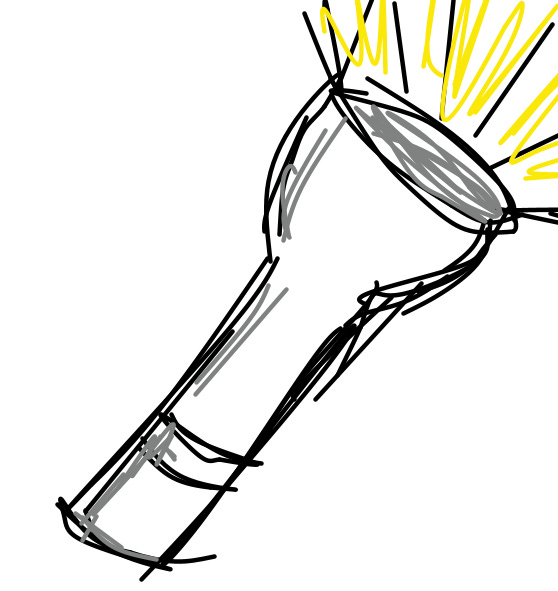
“That’s better,” I thought.
A flashlight doesn’t promise magic. It promises illumination, making visible what’s already there but hard to see. It requires you to point it in a direction, to know (roughly) what you’re looking for, to interpret what you find. The flashlight doesn’t do the thinking. It helps you see where to possibly venture into.
But here’s the thing about flashlights: knowing when to use one matters as much as knowing how. When you’re trying to see stars in a summer sky, a bright flashlight doesn’t help. Instead, it actually destroys your night vision, making it harder to see what’s already there. At that moment, you need to put the flashlight down and let your eyes adjust to the darkness.
The same holds for AI in brainstorming. The question isn’t whether to use the flashlight, but whether it’s helping you see what you’re actually trying to see, and whether what you need right now is illumination or the kind of seeing that only comes from sitting with the dark.
To me, this returns to the situated, relational nature of these tools. The flashlight serves Luke Chang because he’s already developed the night vision—the domain expertise, the pattern recognition, the judgment to know what matters when light hits it. For someone still developing that capacity? The flashlight might be shining too bright, too soon, preventing exactly the kind of adjustment to uncertainty that learning requires.
Knowing how to use the flashlight is different from teaching our students to use it well. We’re sort of asked to do both at the same time. What an interesting time to be in.
What’s your experience with using AI for creative work? I’d love to hear. Reply below.